Image support that suits every child
Three sources of image support in the same app — ready-made pictograms, AI-generated illustrations, and your own photos. Mix freely within the same routine.
With the right image, every routine step becomes concrete, recognizable, and secure — regardless of whether the child is 3, 7, or 12 years old.
How image support works
You don't have to choose between a library, AI, and your own images — Routined has all three. Here's what makes it one of the app's most used features.
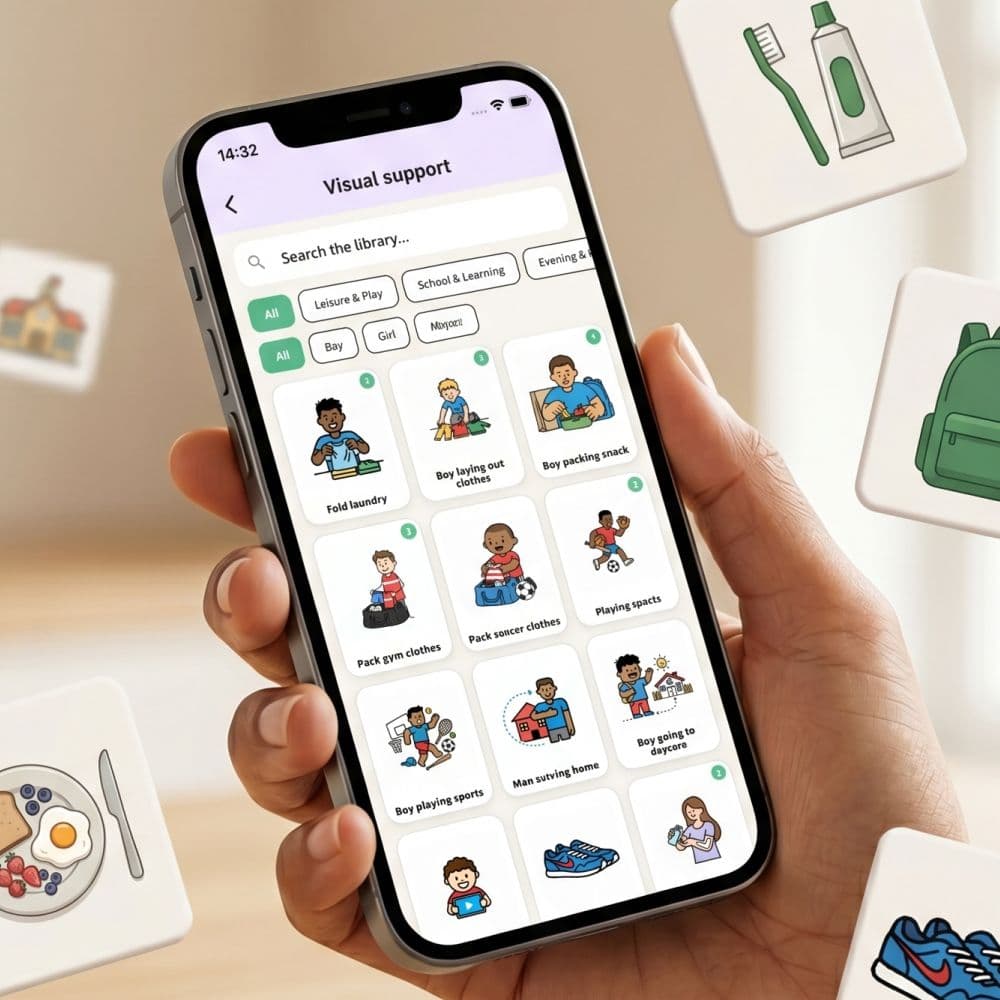
1000+ pictograms for everyday life
Searchable library with clear illustrations for daily routines — from toothbrush and breakfast to school bag and homework desk. No need to search Google for the right image.
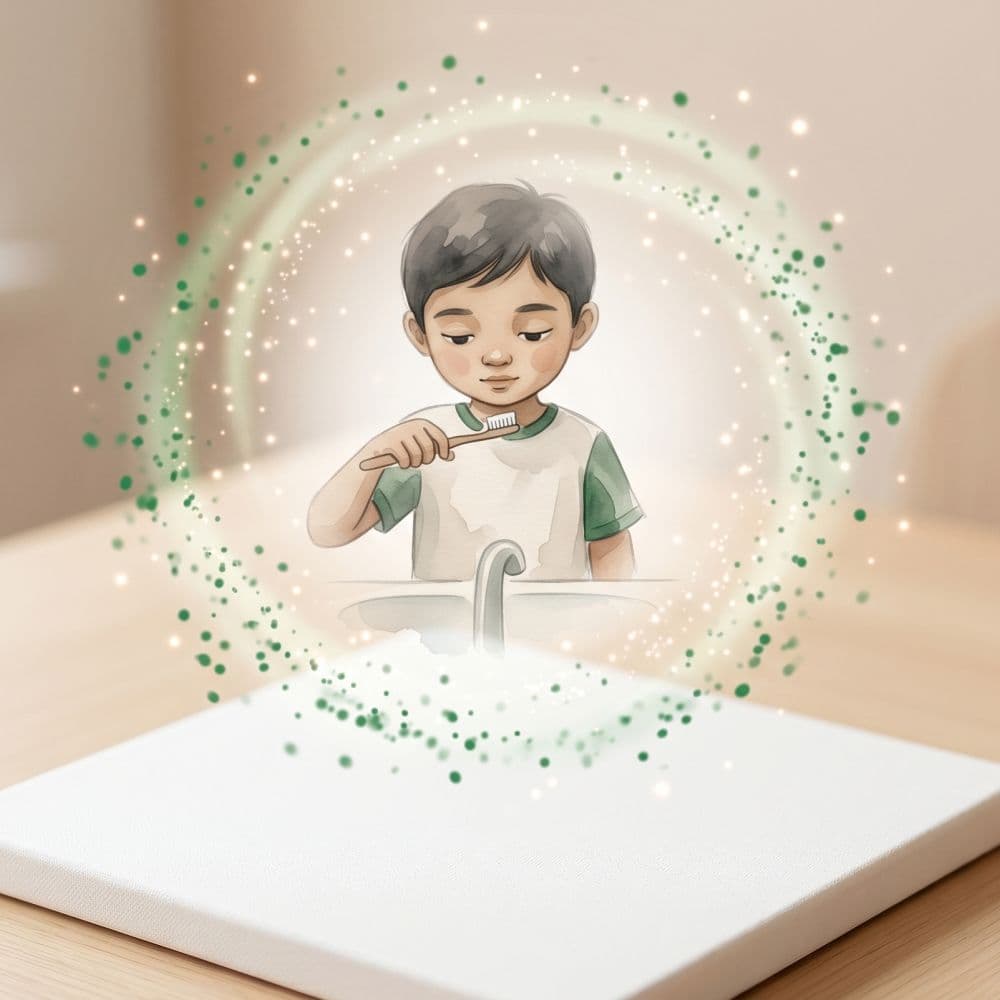
Generate unique images directly in the app
Describe a scene with text — e.g., "brush teeth with blue toothbrush" — and the app creates a unique illustration adapted for children in seconds. No quota, no extra fee.

Photograph the child's own items
For moments where recognition is key — the child's own toothbrush, bed, or jacket. Own photos are often stronger than pictograms for younger children and children with autism who seek concrete details.
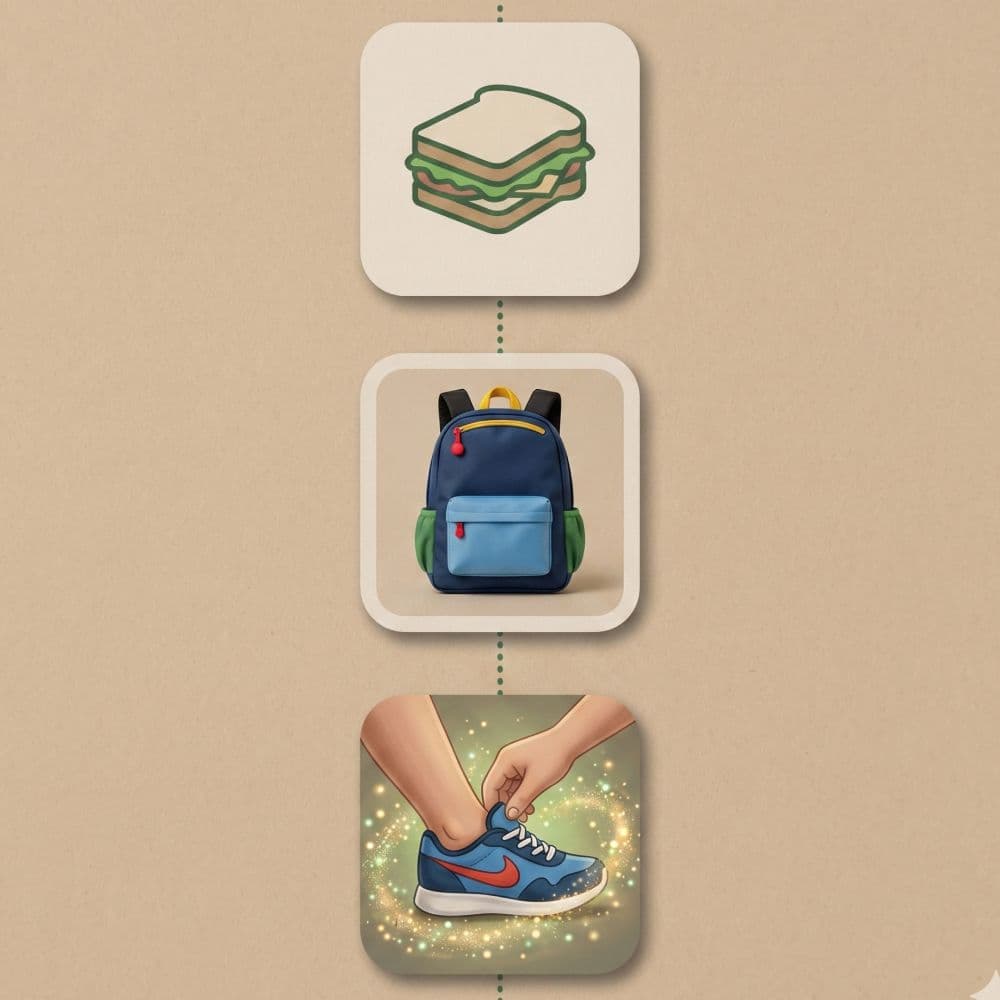
Different sources in the same routine
Standard routines with pictograms, specific moments with photos, unusual steps with AI images — you can mix all three sources within the same routine. Nothing has to be consistent.

Adapt to each child
Big sister and little brother rarely have the same needs. Different images for the same routine are not complicated — it's often exactly what makes the routine work for both.
Why image support is so central for NPF
Image support is not decoration — it is an educational tool that has been used in Swedish habilitation for decades. When the child sees what is going to happen, the brain does not need to hold everything in working memory simultaneously. This frees up mental capacity — and the result is a child who is less stressed, less frustrated, and more present.
A verbal instruction ("come on, lie down and sleep now") can land as white noise for a child with NPF. The brain has to interpret the voice, understand the words, prioritize the action, connect to previous experiences — many processes at once. An image bypasses most steps and says directly: this is what the end looks like. That's why image support often works just as well for non-verbal children as for children who speak freely — it's not about language ability, but about cognitive load.
The difference between image support, pictograms, visual schedules, and drawing talk
You will encounter several terms when you start with visual support for children. They overlap — but have different nuances worth understanding.
Image support is the overarching term — all types of images that help the child understand, communicate, or follow instructions. Image support can be pictograms, photos, AI-generated images, or drawn illustrations.
Pictograms are a specific type of image support — stylized, neutral illustrations (not photos). Classic well-known systems are PCS, Widgit, and Image Support 1 (published by DART at Sahlgrenska). Pictograms are often what you see in classrooms and at habilitation centers.
Visual schedule is a use of image support — when images are put together into a time-ordered sequence. "First toothbrush, then get dressed, then breakfast" presented with images is a visual schedule.
Drawing talk is a specific technique where a parent or educator draws simple images in real-time while talking to the child — often in social situations or to explain feelings. It is not a finished material but a way to communicate.
In Routined, you work with image support that together creates visual schedules — i.e., images that build a visual routine. This does not replace drawing talk, which is a separate tool for spontaneous communication.
Image support for ADHD
For children with ADHD, the problem is rarely understanding what needs to be done — but rather getting started. The classic "lack of drive" makes even simple tasks feel overwhelming if they don't have an immediate reward.
Image support helps in two ways with ADHD:
- Breaks down large tasks into visible micro-steps, which dramatically lowers the initiation threshold.
- Provides quick dopamine feedback when each step is checked off, which keeps motivation up throughout the routine.
Combined with a timer per step (Routined has this built-in), image support becomes a complete tool against the most difficult aspects of ADHD: getting started and staying focused.
Image support for autism
For autism, it's instead about predictability and transitions. What triggers stress is often not the task itself, but uncertainty about what will happen next.
Image support for autism is valuable for:
- Showing the entire sequence of what will happen — not just the next step, but the one after that too.
- Making abstract moments concrete with photos of the child's actual items (often stronger recognition than pictograms).
- Preparing for new situations — dentist visits, hairdresser visits, first time at after-school care.
For non-verbal children or children with speech disorders, image support often becomes the primary communication tool — not just a supplement.
Where to start based on the child's age
3–5 years old
Start with 3–4 very clear pictograms for a single routine (e.g., bedtime). Use the official library. Say the words while looking at the picture, every time — the child connects image to action.
6–9 years old
Extend to 5–7 steps per routine, combine pictograms with your own photos for moments where details matter. Let the child participate in choosing images — ownership of the routine halves resistance.
10+ years and teenagers
Transition to more text and fewer images, but keep image support for moments where details are important (e.g., specific sports equipment). At this age, AI-generated images are often more useful than standard pictograms, as they can show exactly what the child needs.
Image support in preschool and school
Image support is common in Swedish special education and is actively used in preschools and schools — especially for children with NPF, speech disorders, or intellectual disabilities. Routined is not a pedagogical tool in the classic sense (it is a family app), but the image support you build at home functions as a complement to what is done at school.
Tip: If the child's preschool or school also uses image support — try to use the same pictogram system both at home and there. Consistency between environments significantly reduces confusion.
Frequently asked questions
Ready to simplify everyday life?
Download Routined today and start the journey towards a calmer everyday life together with your family.


* 14-day free trial included for new users.