Sit in seat
An assigned chair, a noisy room and a body that needs movement to think – it is not the will that is missing, it is the conditions. The steps below make the rules of the seat visible without silencing the body.
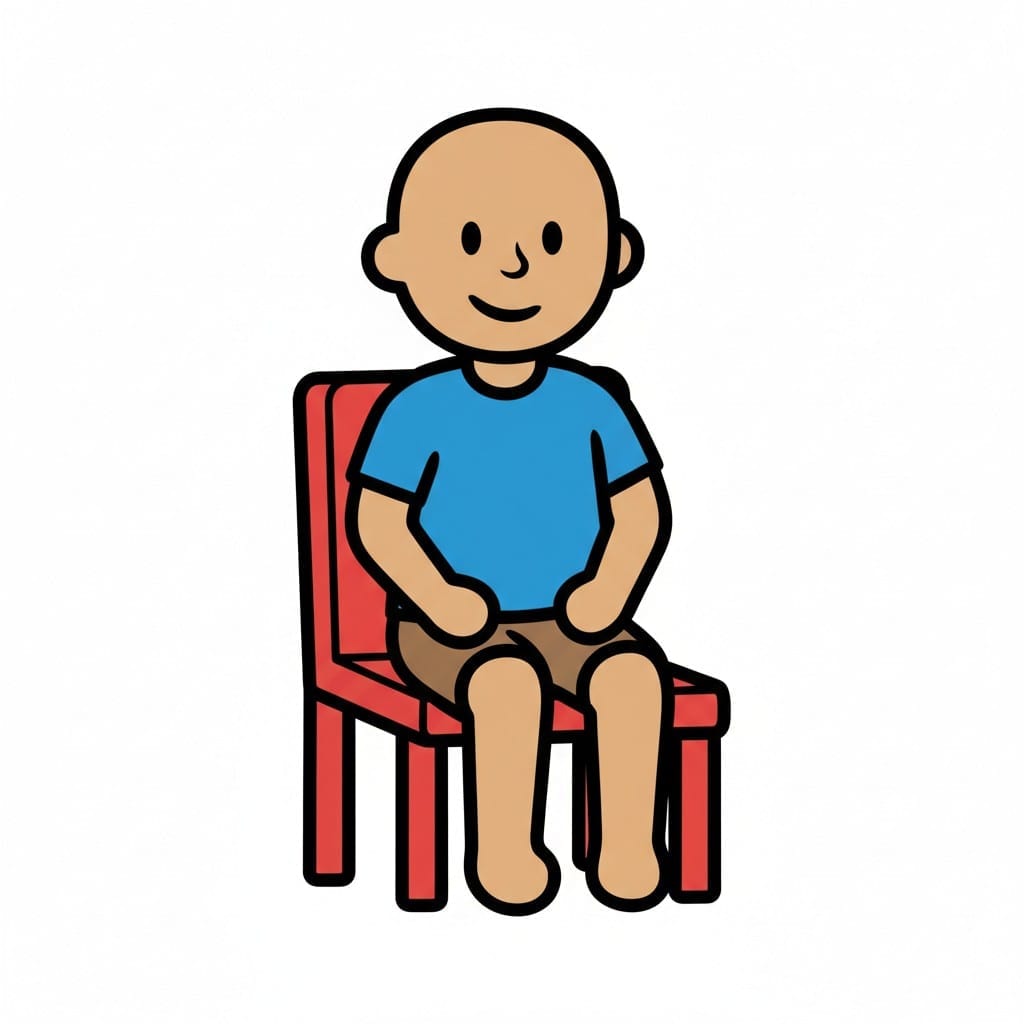 ♂
♂Boy sitting on a chair
A cartoon illustration of a boy sitting calmly on a red chair and smiling.
About this visual support
An assigned seat is not neutral. The chair was chosen by someone else, the neighbour might drum with a pencil, and the body rarely gets to move the way it needs to in order to stay focused. When the child is still expected to sit still, a mental load is added on top of the actual task.
This is where visual support helps by moving the decisions out of the moment. One picture shows where the seat is and where the gaze is allowed to travel, another shows how long – until the next signal or until the task is done – and a third shows what the body may do meanwhile: press the feet together, squeeze a ball, twist the fingers.
A concrete tip: agree with the teacher on a break gesture that lives inside the picture sequence, for example raising a hand that means walking to a wall and pressing for a moment before coming back. Movement becomes part of the seat rather than a violation of it.
Save the sequence in Routined per lesson or per day, so the same seat stays equally clear on Monday and on Friday.
Use this image in a schedule
Build your own visual schedule with this image and download it as a print-ready PDF. Completely free.

More similar visual supports
Settle into chair
An armchair, a chair and a stool.
Sit down
A smiling boy in a blue shirt and brown shorts sits on a red chair, looking forw...
Be quiet
An illustration of a person holding a finger to their lips to signal to be quiet...
Christian studies
A smiling pupil points at a large open blue book showing a cross and a scroll, b...

Circle time
A group of people standing in a circle holding hands, with one person in the cen...

Danish
A round pastry icon with golden petals, white sprinkles and a red round filling ...

Fetch pen and paper
A boy reaches toward a sheet of paper while holding a pen.
Follow instructions
A happy boy runs with his arms outstretched.
Take the visual supports with you
In Routined you build schedules from these pictures, add timers and voice instructions, and your child follows the day on their own.


* 14-day free trial, then $2.39 a month or $20.99 a year (US pricing). Cancel anytime.