Light Spring Evenings Are Wrecking Your Child's Sleep — How to Protect Bedtime When It's Still Bright Outside
It's 9 PM and the sun is still up. Your six-year-old is bouncing off the walls and bedtime has been a 90-minute negotiation for two weeks. Light Nordic spring evenings sabotage melatonin and wreck bedtime — here's the practical fix that doesn't require blackout curtains in every room.

It's 9 PM. The sun is still very much up. Your six-year-old has been "going to bed" for ninety minutes. Yesterday she finally fell asleep at 10:40. This morning's wake-up was a tragedy. By dinner she will be a small, irrational person whose nervous system has not slept enough.
If this is your house in May, you are not alone — and you are not failing. The Nordic spring is doing this to your child's body. The good news is that the fix isn't blackout curtains in every room. It's a small set of evidence-based moves that work even when the sun ignores your bedtime.
What light actually does to a child's brain
The hormone that makes us sleepy is called melatonin. It is produced by the pineal gland in response to darkness. When light hits the retina — especially blue-wavelength light from sky, screens or bright bulbs — melatonin production is suppressed.
In children, this effect is stronger than in adults. Children's pupils are larger and their lenses are clearer, so more light reaches the back of the eye. Studies have found that children's melatonin can be suppressed by half or more with just an hour of bright evening light, compared to about 10% in adults. The same evening light that an adult barely notices is biochemically broadcasting "still daytime" to a child's brain.
In the Nordics this matters a lot. In Stockholm, by mid-May the sun sets after 9:30 PM. By mid-June it doesn't really set at all in any meaningful way. Your child's bedroom may be objectively as bright at 9 PM in late May as it is at 4 PM in November. The brain doesn't know what month it is. It only knows what light is doing.
This is why bedtime suddenly becomes a fight in May, eases slightly in late August, and is fine by October.
The fix: three layers, in order
You don't need to do all of these. Start with the first one. Add the next if the first isn't enough.
Layer 1: Protect the last 60 minutes before bed (the easy win)
You don't need to darken the whole house. You need to darken the last hour before bed in the spaces the child is in.
Concretely:
- Turn off overhead lights 60 minutes before bedtime. Use lamps with warm, dim bulbs instead.
- Close curtains in the living areas where the child is in the evening — even if it's bright outside.
- No screens in the last 60 minutes. The blue light from screens is the most efficient melatonin suppressor we know of. Just one TikTok session before bed is biologically equivalent to standing outside.
- Slow the music, lower the volume, slow your own movements. Bedtime is a state, not a time.
For many families, this layer alone solves the spring bedtime drift.
Layer 2: Darken the actual bedroom (the highest-leverage fix)
If the first layer isn't enough — bedtime is still a battle, the child wakes at 4:30 AM with the sun, or both — invest in real bedroom darkness.
Options, ranked by effectiveness and cost:
- Blackout blinds installed in the window frame. Most effective. Around 400–1500 SEK per window. Worth it for the child's bedroom and the parent's bedroom. The rest of the house doesn't matter.
- Blackout curtains over the existing curtain rod. Cheaper, easier to install, but light leaks around the edges. Effective enough for many kids.
- Sleep eye masks for kids. From age 4 or so, many children tolerate these. Not for everyone — sensory-sensitive children often refuse them — but cheap and worth trying.
A child's bedroom should be dark enough that you can't see your hand in front of your face. That's the standard. Don't compromise on this if you can avoid it; bad sleep cascades into everything else.
Layer 3: Shift the rhythm gently (the long fix)
If your child has slipped to a 10:30 PM natural bedtime over the past three weeks, you cannot just announce that bedtime is now 8:00 again. The body doesn't work that way. You'll get a child lying awake in a dark room for 90 minutes — not better than the previous situation.
The fix is to move bedtime back by 15 minutes every 3 days. So if you've drifted to 10:00 PM and you want 8:30:
- Days 1–3: bedtime 9:45
- Days 4–6: bedtime 9:30
- Days 7–9: bedtime 9:15
- Days 10–12: bedtime 9:00
- Days 13–15: bedtime 8:45
- Days 16+: bedtime 8:30
Pair this with earlier wake-up during the same period. Daylight at the start of the day is a more powerful clock-shifter than darkness at night. A child waking up by 7:00 AM is a child whose body will accept an 8:30 PM bedtime two weeks later.
What about the wind-down sequence itself?
Even with the right environment, a chaotic wind-down ruins bedtime. A predictable visual sequence — same steps, same order, every night — is one of the strongest sleep-supporting tools in parenting.
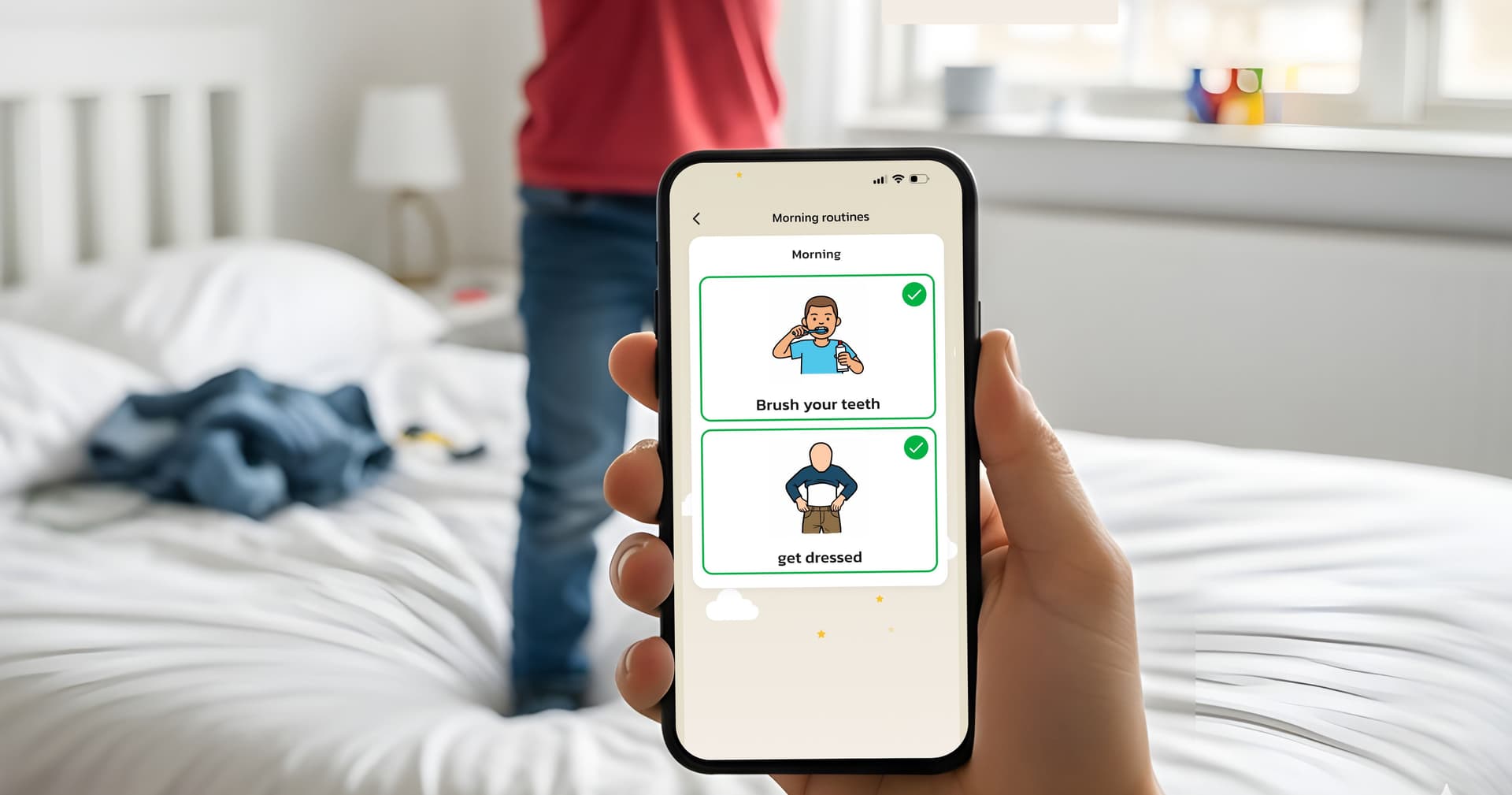
A four- or five-step evening routine on the wall or in a routine app does the same thing for evenings that it does for mornings: removes the verbal nagging, gives the child agency, and pulls the brain into "we are heading toward sleep now" mode.
In Routined, you can build the wind-down as a sequence — snack, pajamas, teeth, story, lights out — with a small picture per step and an optional timer. For children who fight the transition into bed itself, a soft voice recording from a parent on the last step ("you did everything; we're proud of you; goodnight") helps many kids settle. The recordings persist across nights, so even if you're working late or away, the routine still runs the way it should.
Light spring evenings are not your imagination, and they are not just an inconvenience. They have a real, measurable effect on children's sleep biology. Protect the last hour, darken the bedroom, shift the rhythm gradually — and bedtime can be normal again, even when the sun stays up until ten.
Frequently asked questions
My child wakes up at 4:30 AM with the sun, not the alarm.
This is a darkness problem, not a tiredness problem. Layer 2 (real blackout in the bedroom) is the answer. Even kids who fall asleep fine at 8:30 PM will wake at the first bright light if the bedroom is bright by 4:30 AM.
Can I just give melatonin supplements?
For most children, you shouldn't need to. Light management works for the majority. Melatonin supplements for children should be discussed with a pediatrician — especially for children with ADHD or autism, where they sometimes do have a role, but in carefully chosen doses.
My partner thinks darkening the bedroom is too much.
It isn't. A child's bedroom should be dark for sleep. This is not a controversial position in pediatric sleep medicine. The argument is usually about aesthetic, not function — you can choose blackout curtains that look beautiful.
My teenager won't accept any of this.
Teenagers' melatonin cycles shift biologically; they genuinely do feel less tired earlier in the evening. You can't fix that. What you can do is enforce no-screens in the last 60 minutes and a dark room. The exact bedtime can be negotiated.
It's already June and bedtime is a disaster. Is it too late?
No. You can reset in 2–3 weeks using the Layer 3 protocol. The earlier you start, the easier — but a July reset still works. Don't wait for autumn to do it for you.