Activity Training
Practising a new skill is the brain's idea of thankless work: the same thing again and again with nothing visible to show. The steps below break the skill into pieces a child can actually see moving.
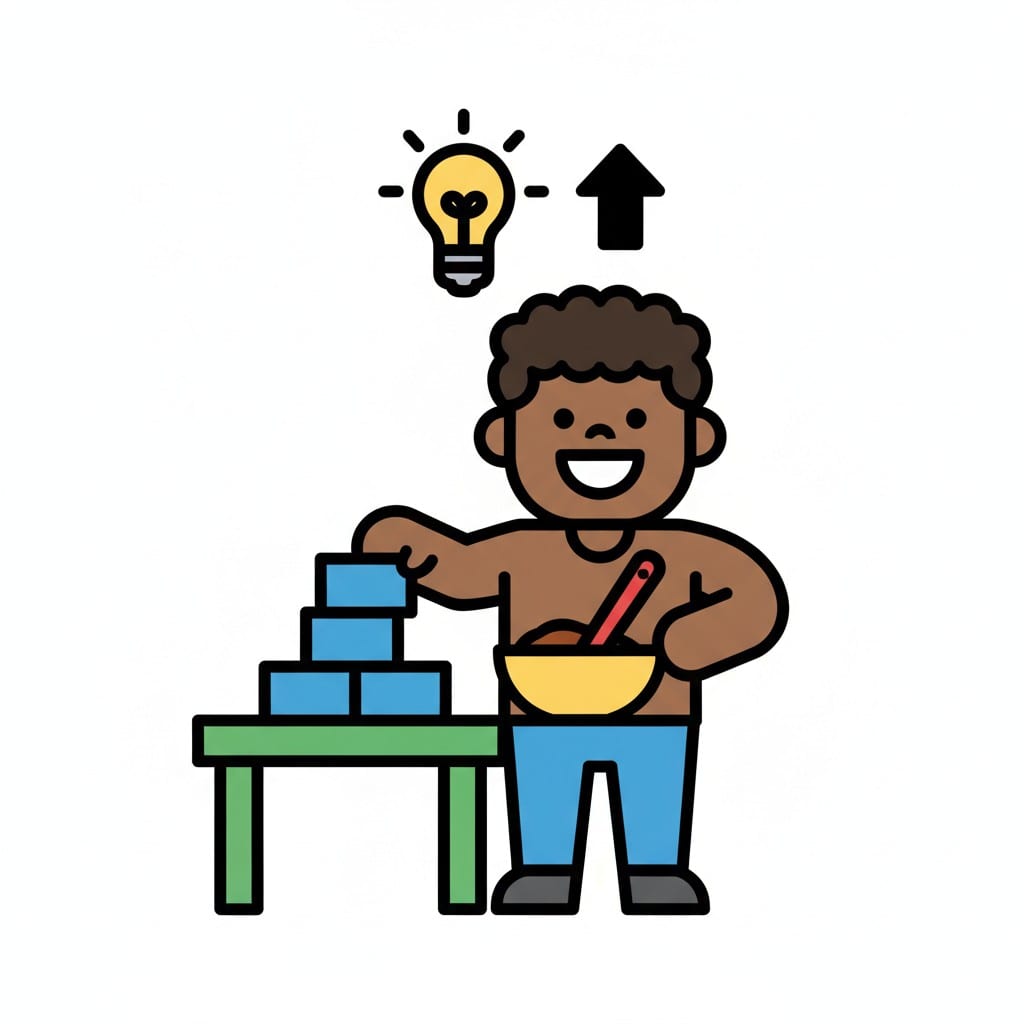 ♂
♂Boy building and getting an idea
A smiling boy is building a tower of blue blocks on a green table. Above his head, a bright lightbulb and an upward arrow symbolize a new idea or development. He is also holding a yellow bowl with a red spoon.
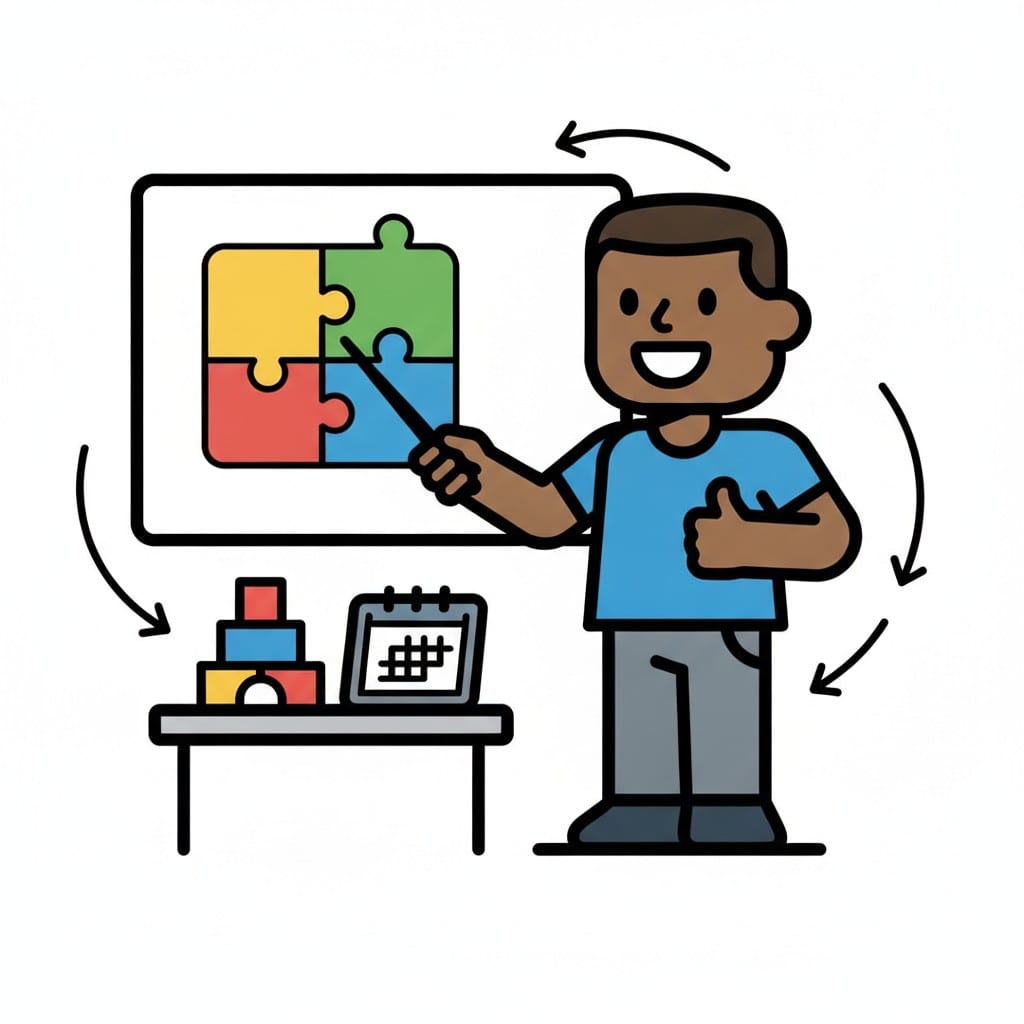 ♂
♂Man showing an activity on a whiteboard
A man in a blue t-shirt points a stick at a whiteboard showing a four-piece puzzle, gives a thumbs up, and has a table with building blocks and a calendar beside him.
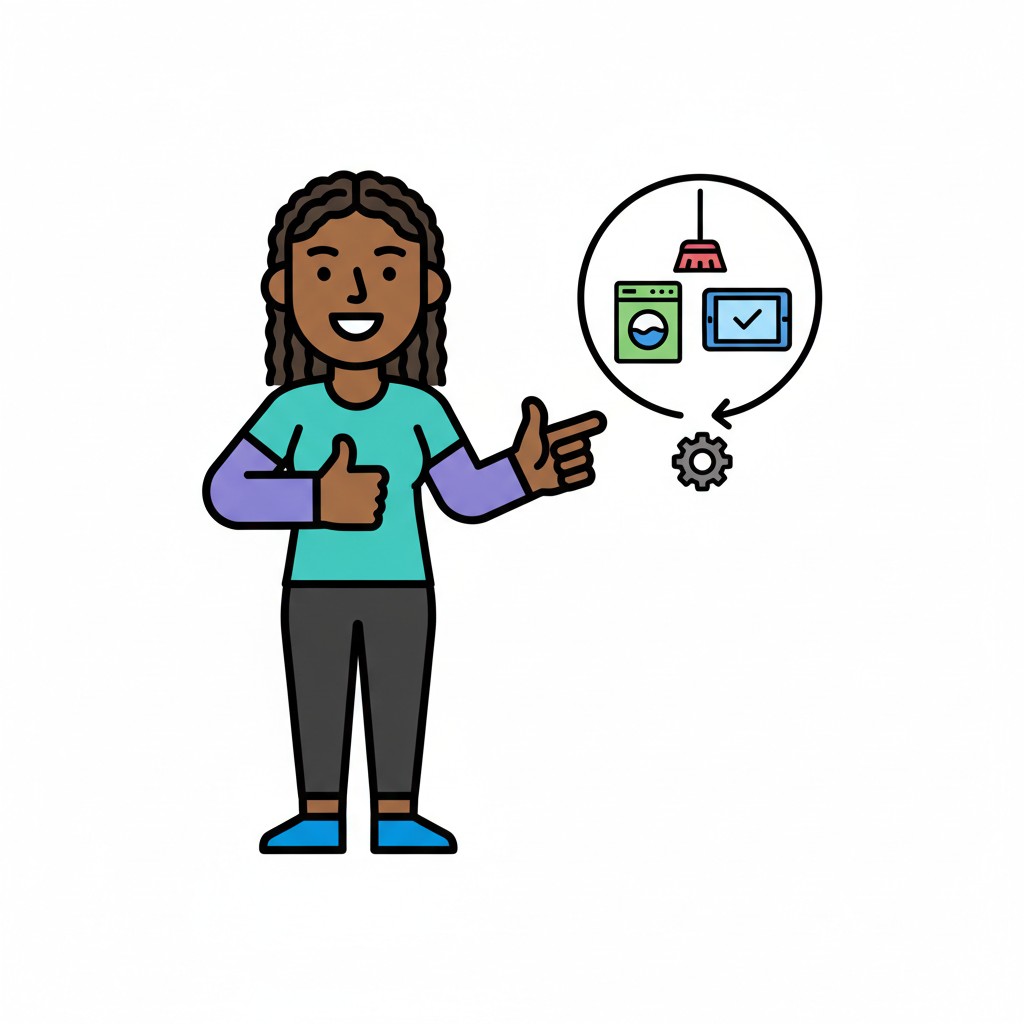 ♀
♀Woman pointing to activities
A woman gives a thumbs-up and points to a circle with symbols for household tasks.
About this visual support
Skills are built through repetition, but repetition by itself is a poor reward system. The brain wants proof that effort goes somewhere, and when ten attempts in a row look identical, most children lose faith before the body has time to learn. That's not laziness; it's a reasonable protest against invisible work.
A picture sequence lets you split the skill so progress shows even when the whole thing isn't there yet. Tying laces becomes 'cross over', 'pull tight', 'make a loop', 'thread through'. When the child manages step three but not four, there's something to look back on and something to aim at. Practice shifts from 'I can't do this' to 'I'm on part four'.
One tip: mark which step you're working on right now with an arrow or a moved magnet. It answers the question 'how much is left' without words and makes the target concrete. In Routined you can tick off sub-steps so attention stays on the part actually being trained.
Use this image in a schedule
Build your own visual schedule with this image and download it as a print-ready PDF. Completely free.

More similar visual supports
Ballet
A laughing dancer with long hair in a light blue top and pink tutu jumps with le...
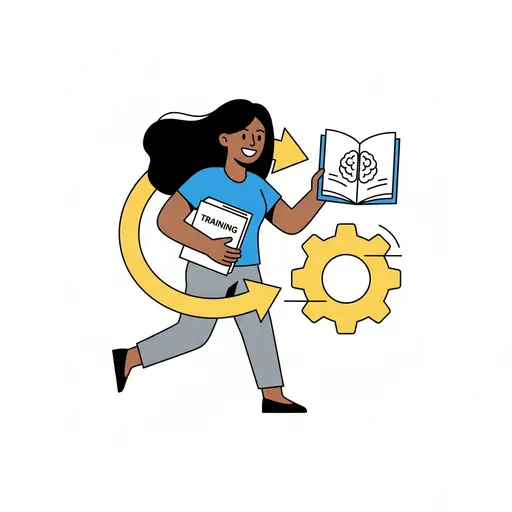
Get changed for training
A woman strides forward with a folder labelled Training under her arm and an ope...
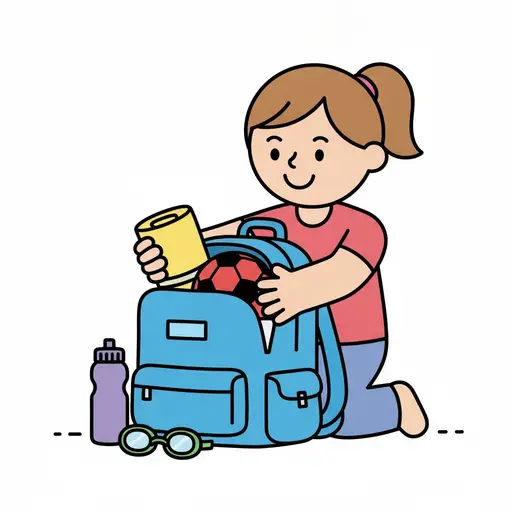
Pack for activities
A girl packs a blue backpack with a ball and a rolled towel, and a water bottle ...
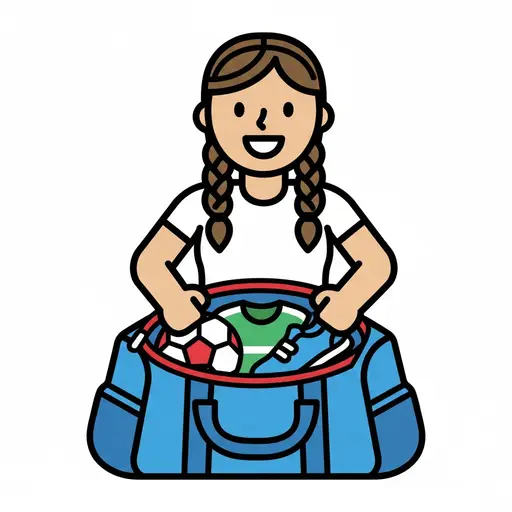
Pack for sports
A girl with braids holds open a blue sports bag packed with a football, a jersey...
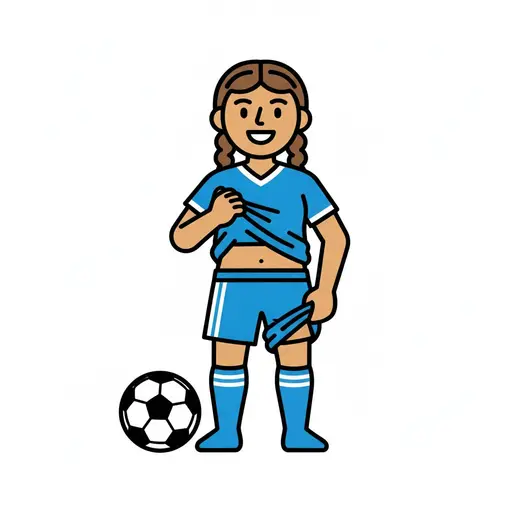
Put on football kit
A girl pulls on her blue football shirt with a ball beside her.
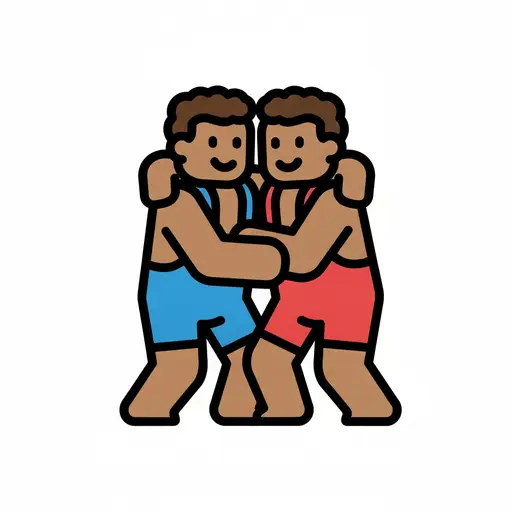
Wrestling
Two boys in blue and red singlets hold each other in a wrestling grip.
5000 Steps
A blue sneaker with the number 5000 and arrows showing movement.
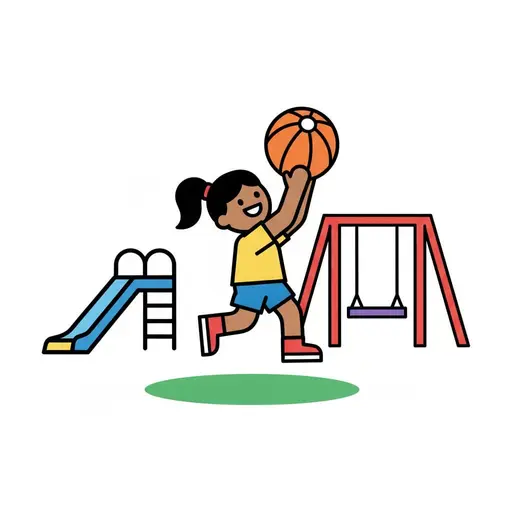
Active play
A girl jumps with a basketball in a playground with a slide and swings.
Take the visual supports with you
In Routined you build schedules from these pictures, add timers and voice instructions, and your child follows the day on their own.


* 14-day free trial, then $2.39 a month or $20.99 a year (US pricing). Cancel anytime.