The After-School Crash: Why Your Child Falls Apart at Pickup (and the First 30 Minutes That Fix It)
Held it together all day at school — and explodes the moment you say hello at pickup. It has a name: restraint collapse. Why "the good kid at school" comes apart at home, and the 30-minute decompression protocol that prevents the daily disaster.
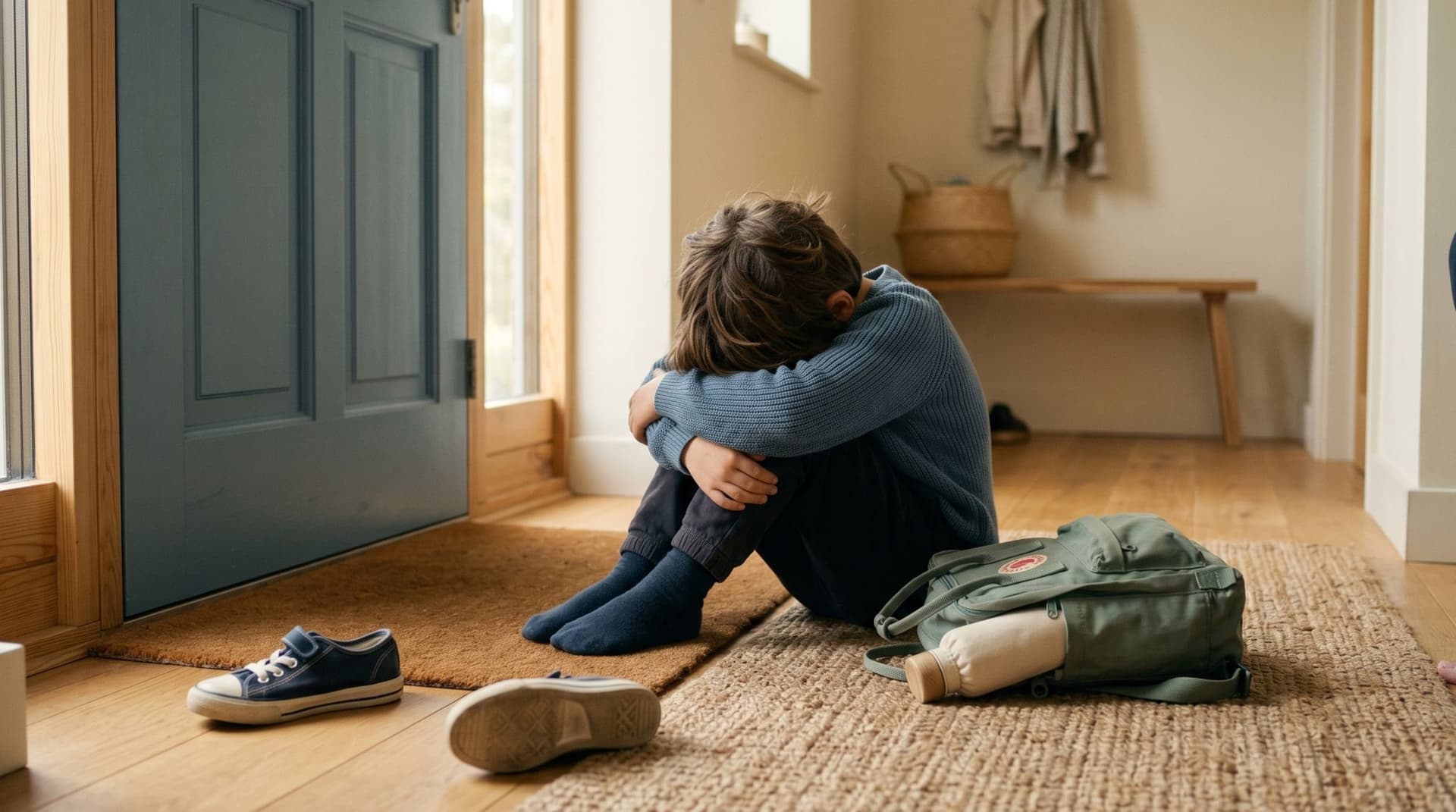
"How was school?"
Three seconds later, your seven-year-old is screaming on the pavement because the wrong pocket of the backpack is unzipped. The teacher told you they had a great day. The friends' parents say their child was wonderful. So why does your child fall apart the second they see you?
This is called restraint collapse, and it's one of the most misunderstood patterns in family life.
What restraint collapse actually is
For six or seven hours, your child has been performing self-regulation at full intensity. They've been sitting still when they wanted to move. Following instructions when they wanted to play. Managing social dynamics with twenty other small humans and three demanding adults. They've been masking discomfort, ignoring sensory input they don't like, suppressing the urge to cry when something went wrong.
This requires enormous prefrontal effort. The brain treats it as exhausting work — because it is.
Then they see you. Their safe person. The one face in the world they don't have to perform for. And the entire scaffolding collapses at once.
This is not bad behavior. It is the predictable result of a small human running on fumes finally hitting safe ground. The screaming, the rigidity, the "I hate everything" — that's the release of six hours of held tension, not a critique of you or the day.
The teacher isn't lying when they say your child was lovely. You aren't being treated badly because you've failed somehow. You are being treated like the safe person you are. Which is the right answer biologically, even though it feels like the wrong answer practically.
Why it's worse for some kids
A few patterns make restraint collapse more intense:
- Neurodivergent children (ADHD, autism, sensory processing differences) burn through self-regulation faster during the school day. They arrive at pickup with less in the tank.
- Younger children (4–8) have shorter regulation runways to begin with.
- Introverted children spend the day in constant social input. The deficit is social, not just behavioral.
- Kids in transition periods — new school, new teacher, friendship reshuffling — are running an extra background process all day.
If your child is in one or more of these categories, expect restraint collapse to be a daily event, not an occasional one. Plan for it the way you'd plan for a known traffic pattern.
The first 30 minutes — a protocol
The fix isn't to demand better behavior at pickup. It's to redesign what happens in the 30 minutes after pickup so the collapse has somewhere safe to go.
Minutes 0–5: No talking
Do not ask about school. Do not ask about homework. Do not ask about lunch. Do not ask anything.
A warm hello, a brief touch if welcomed, and then quiet. Walk to the car. Drive home. Let them sit with their phone or stare out the window. If they want to talk, they will. If they don't, the silence is part of the fix.
This single change — replacing "how was your day?" with quiet — eliminates a measurable fraction of pickup meltdowns on its own.
Minutes 5–15: A predictable transition ritual
The same ritual every day. It does not have to be elaborate.
Examples that work:
- A specific snack waiting at the kitchen counter — same one every day for at least a month.
- A 10-minute "quiet zone" with screens, a fidget, or a book.
- A short outdoor moment — backyard, balcony, even just opening a window and standing near it.
The brain is looking for predictability, not novelty. The ritual is what it is, every day, in the same order. Boring is good. The boredom itself is regulating.
Minutes 15–30: Movement or sensory release
Once the initial regulation has happened, many children need to discharge the held-in energy from the school day. This is not a misbehavior to manage; it is biology asking to be honored.
Options:
- Trampoline, bike, scooter, or running in the garden
- A loud-music dance break in the living room
- A bath or shower (the warm water + privacy is a powerful regulator)
- For sensory-seeking kids: heavy work like carrying laundry, pushing a chair, hanging from a bar
After this movement window, most children are noticeably more regulated. This is when you can ask about the day, look at homework, plan dinner. Not before.
What to skip in the first 30 minutes
- Don't schedule activities right after pickup. A 4:00 PM piano lesson on top of restraint collapse is a setup for disaster.
- Don't run errands on the way home unless absolutely necessary. The grocery store at 3:30 PM is the worst place for an unregulated child.
- Don't probe. "What did you do today? Who did you sit with? Did Sara talk to you?" feels like care; it lands as another set of demands.
- Don't deliver consequences for the meltdown itself. The meltdown was the regulation event. Punishing it is like blaming a fever on the patient.
How a visual routine helps
If you use a routine app like Routined, this is one of the highest-leverage places to set one up. A short visual sequence on the kitchen counter — snack, quiet time, outside — does several things at once:
- Replaces verbal demands ("come eat your snack now") with visual cues the child can follow on their own.
- Eliminates the negotiation that would otherwise happen at exactly the moment the child has zero negotiation capacity.
- Builds the predictability the nervous system is begging for.
- Frees the parent from being the "what do we do next" voice in the room.
A per-step timer on each step also helps, especially for time-blind ADHD children. They can see when the snack ends, when the quiet time ends, when the movement window starts. Knowing the structure is itself a regulator.
The after-school meltdown isn't a sign that your child is failing or that you're parenting wrong. It's the visible part of an invisible workday. Design the first 30 minutes for decompression, not productivity, and most of the daily drama goes away on its own.
Frequently asked questions
My child is fine at pickup but melts down at 5:30. Same thing?
Often yes — it's the same restraint collapse, just delayed. The hold-it-together window stretched a little further before breaking. The 30-minute protocol still applies; just start it later.
Should I tell the teacher they're falling apart at home?
Yes, but as information, not as a complaint. Many teachers don't realize the gap between school behavior and home behavior. It helps them calibrate expectations and, sometimes, identify support needs.
My partner thinks I'm being too soft.
This isn't softness; it's biology. A child in restraint collapse can't access the part of the brain that responds to correction. Demanding more from someone running on fumes makes the next day worse, not better. If your partner needs convincing, observe one pickup together without intervening.
What about siblings? They want my attention too.
Stagger if possible. The child returning from school gets a 30-minute decompression window before the family resumes its full noise. If there's a sibling at home all day (preschooler, baby), have a parallel quiet activity ready for them so the returning child gets the space they need.
Does this fade with age?
Yes, for most kids, but slower than you'd hope. A 14-year-old who slams the door and disappears to their room for an hour is doing the same thing as the 7-year-old screaming about the pocket — they've just developed a more socially acceptable version. Either way, give them the room.