How to Stop Shouting at Your Child (and What to Do When You Already Have)
You promised yourself you would not do it again, and then Tuesday happened. Here is how to interrupt the pattern earlier, and how to repair it well.
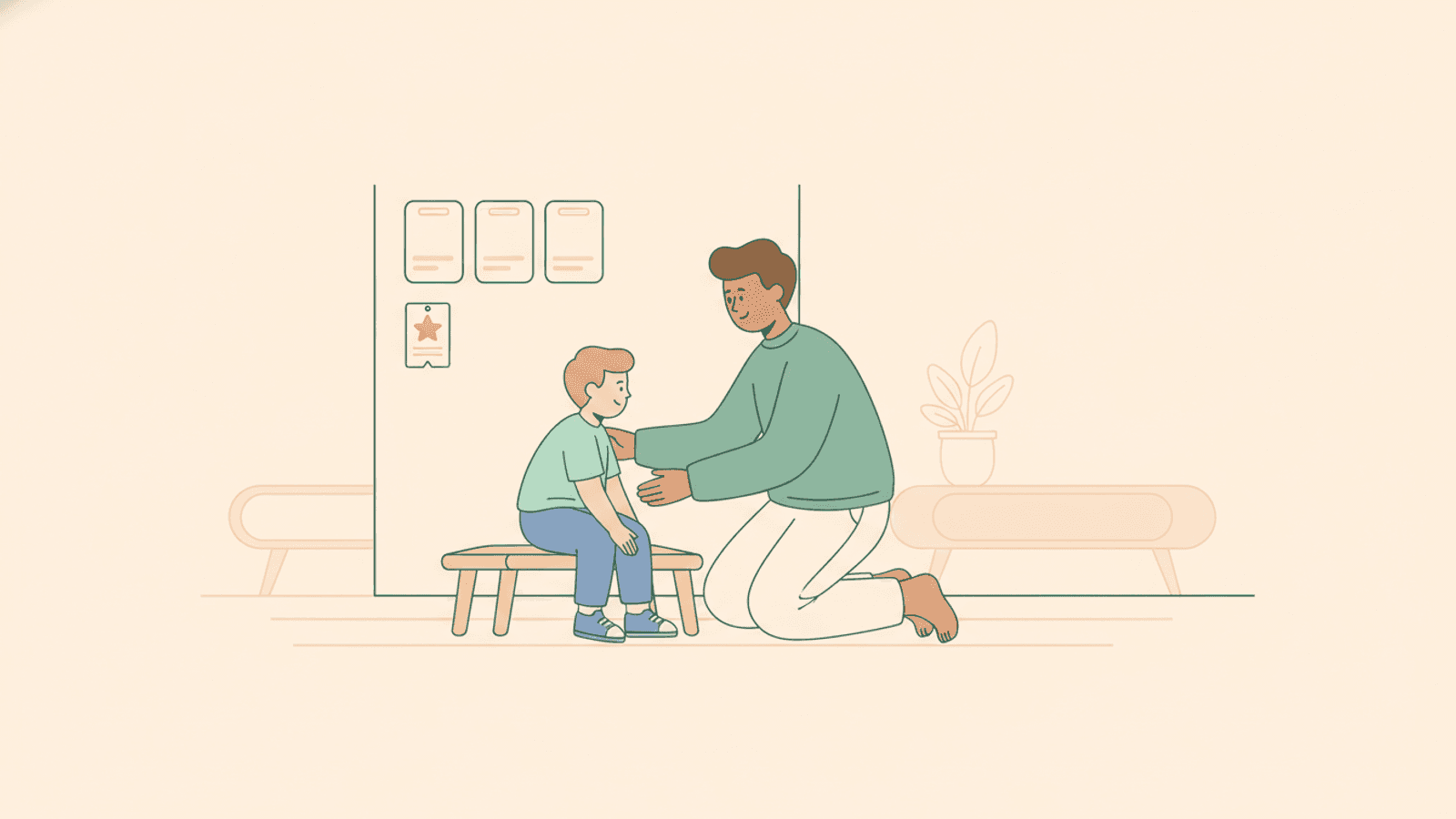
To stop shouting at your child, you have to intervene earlier than the moment you shout. By then your body has already made the decision. Shouting is a stress response: your own arousal climbed past the point where the thinking part of your brain was steering, and volume came out instead. The work happens in the minutes before, in the conditions that keep producing that moment, and in the repair afterwards.
That is also the good news. This is not a character trait you are stuck with. It is a pattern with recognisable warning signs, and patterns can be interrupted with practice, even by parents who have been losing it every evening for a year.
Why you shout, even though you know better
Nobody shouts from a calm baseline. It sits at the top of a ladder you have been climbing for a while: you asked, you asked again, you were ignored, the clock moved, your own tiredness was already there, and each rung raised your arousal a little. The last rung looks like the cause, but the ladder is the cause.
The fourth ask is where most parents go. The first three requests were reasonable. By the fourth, you have stopped hearing your own voice and started hearing what you think it means: that you are not respected, that you have failed at this, that tomorrow will be the same. That interpretation is what turns irritation into anger.
Know your own triggers
Almost all shouting has a state behind it. For one week, note what was going on right before. Most parents find the same short list.
- Tired, hungry, or in pain. Your window for stress is physically smaller. This is not weakness, it is physiology.
- Running late. Time pressure is the single most common condition behind a raised voice.
- Noise. Especially several sources at once. If sound overloads you, that is a real trigger, not an excuse.
- Being ignored. Repeating yourself is the strongest predictor of the fourth-ask escalation.
- Being watched. In public, or in front of family, shame speeds the whole ladder up.
Knowing your triggers is not the same as removing them, but it changes what you do at the first sign. A parent who thinks "I am hungry and we are late, this is my danger zone" behaves differently from one who thinks "why is this child impossible".
The ten seconds before
When you feel it building, the goal is not to be calm. It is to buy ten seconds so the thinking part of your brain can come back online.
- Go quieter, not louder. Drop your volume deliberately. It is physically hard to escalate while whispering, and it makes your child listen harder.
- Slow your speech. Half speed. Speed and volume rise together, so slowing one lowers the other.
- Sit down. Changing your posture changes your state, and standing over a child raises theirs.
- Say it out loud. "I am getting angry and I need a minute." This is not weakness in front of your child, it is a demonstration of the skill you want them to learn.
- Leave the room if it is safe. Twenty seconds by the sink beats twenty minutes of repair.
- Drop the demand for now. The shoes will still be there in two minutes. Nothing you win in this state is worth what it costs.
If your child is already past the point of no return, this is not the moment for teaching or consequences either. The priority is bringing the temperature down for both of you: see what to do in the moment.
If you have already started
You can stop mid-sentence. It is awkward and it works: "I am shouting. I am going to stop and start again." Children are far less disturbed by an adult who catches themselves than by one who keeps going because the sentence had momentum.
Design the day so it comes up less
Willpower is the weakest of the tools available. The strongest is a day that produces fewer of these moments in the first place, which mostly means fewer surprises and less repeating yourself.
- Forewarnings. Most explosions happen at transitions. A five-minute heads-up costs nothing and prevents an astonishing number of them.
- Fixed sequences. When the order of the evening is decided in advance, you are not negotiating it while tired.
- Move the flashpoint. If it is always the 07:40 hair-brushing, do the hair the night before, not better.
- Fewer things at once. One activity fewer in the week is a real intervention on your temper.
Two of those have their own guides here: transitions and forewarnings and a ready-made routine schedule you can adapt.
This is where Routined helps in a very ordinary way. When the steps are visible, with a picture and a timer on each one, your child follows the plan instead of your voice, and you stop being the reminder that has to escalate. Both parents see the same routine in real time, so the same evening runs whoever is home.
Repairing afterwards, properly
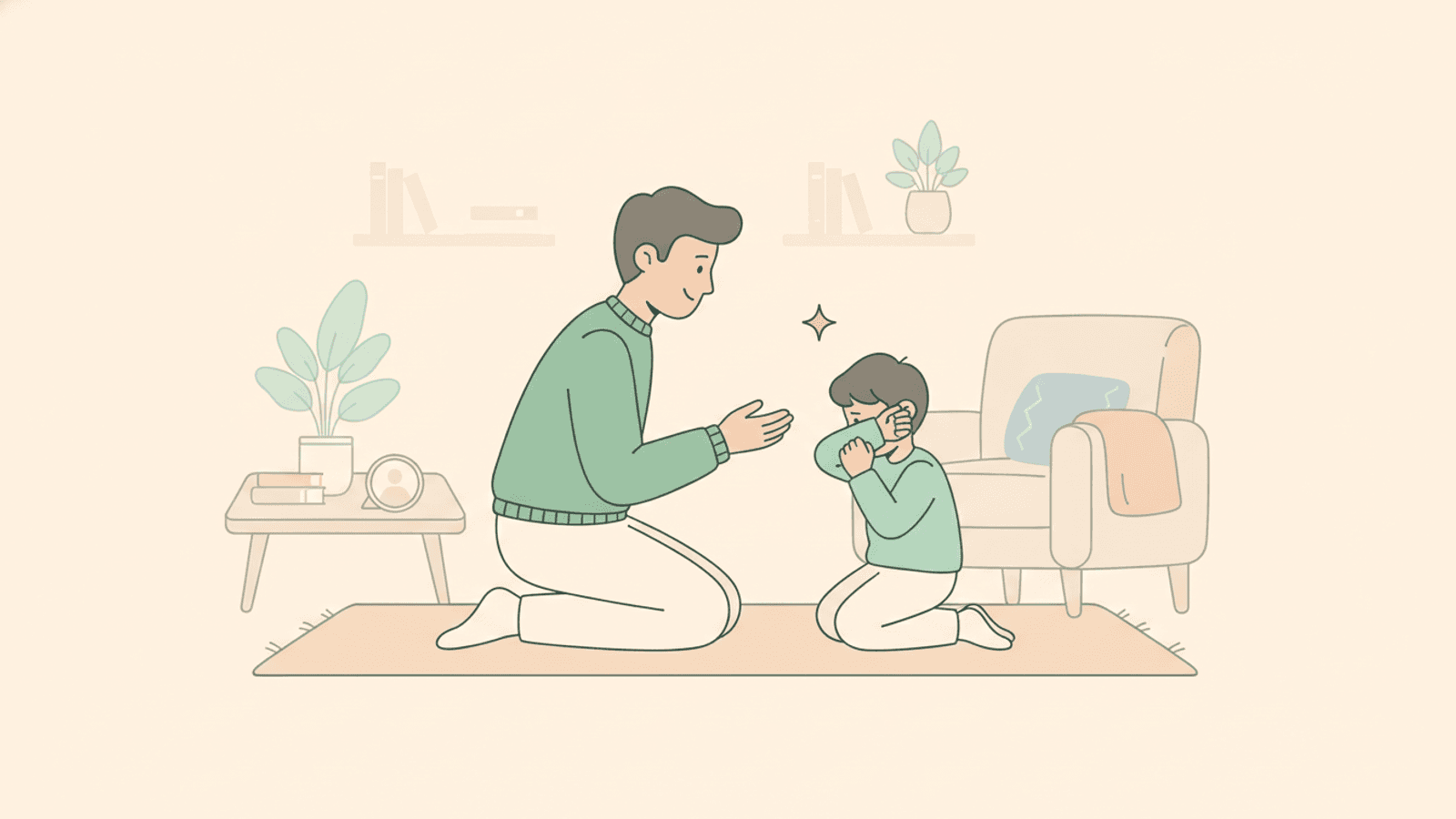
Every parent loses it sometimes. What matters far more than the rupture is whether it gets repaired, because that is how children learn that conflict is survivable and that they are not responsible for adult feelings. A good repair has four parts and takes about thirty seconds.
- Name it. "I shouted."
- Own it without conditions. "That was not okay, and it was not your fault." No "but you were" — that hands the blame straight back.
- Say what you will try. "Next time I am going to leave the room before I get that angry."
- Reconnect. Do something ordinary together. Reconnection is the part children actually register.
Keep it short. Long, emotional apologies turn the child into your comforter and make them anxious about your feelings. Do not ask them to reassure you, and do not repair in the middle of the storm; wait until you are both regulated, which can be an hour later or the next morning.
By age, roughly: a four-year-old needs a sentence and a cuddle. An eight-year-old needs the sentence plus what you will do differently. A teenager needs it brief, unsentimental and without an audience, and may not respond at all in the moment. That is normal, and it still lands.
When it keeps happening
If shouting is the default rather than the exception, treat it as information about the load rather than about you. Look for the pattern: same time of day, same task, same child, same week of the month. Then change the condition, not the intention. If your child is the one escalating repeatedly, the guide to helping a child manage anger is a better place to start than another resolution to stay calm.
Get outside support if you frighten yourself, if it has ever become physical, if you cannot stop once you start, or if the anger is bigger than the situation most days. Talk to your doctor or local health service. Research on harsh verbal discipline consistently links frequent shouting, insults and put-downs with worse outcomes for children, which is exactly why this is worth taking seriously rather than carrying alone. This article is general information, not medical advice.
A week of practice
- Days 1–2: notice only. Write down what happened just before, no changes yet.
- Day 3: pick the single most common trigger and change one condition around it.
- Days 4–7: practise going quieter instead of louder. It is a physical habit, so it needs repetition.
- All week: repair every time, briefly, and let your child see it.
Read more
- Meltdowns: what to do in the moment — and what to do the day after.
- Helping your child manage anger — the other half of the same problem.
- Transitions and forewarnings — the five-minute habit that prevents most flashpoints.
Frequently asked questions
Is shouting at your child harmful?
Occasional raised voices in a warm relationship that gets repaired are not what harms children. What research on harsh verbal discipline consistently links to worse outcomes is the frequent version: regular shouting, insults, name-calling and put-downs. If shouting has become the normal way things get done in your home, that is worth changing, and it is changeable.
How do I stop when I have already started?
Stop mid-sentence and say so: "I am shouting. I am going to stop." Then lower your volume deliberately, slow your speech, and drop the demand for a couple of minutes. Children are much less affected by an adult who catches themselves than by one who carries on.
Should I apologise to my child for shouting?
Yes, briefly. Name what you did, say it was not their fault, say what you will try next time, and then do something ordinary together. Keep it short: long apologies make the child responsible for comforting you, which is the opposite of what a repair is for.
Why do I only shout at one of my children?
Usually because that child triggers the ladder faster, not because you love them less. It may be the one who repeats, resists transitions or reminds you of something in yourself. Look at the specific situations rather than the child, and change those, then say out loud to that child that the problem was the moment, not them.
What if my partner is the one who shouts?
Raise it when nothing is happening, not in the moment, and talk about the conditions rather than their character: what time it happens, what preceded it, what would help. Agree a code phrase that means "I will take over", so either of you can hand over without losing face in front of the children.