Write diary
Blank page, no assignment, and a brain that has to put a whole day into words before bed calls. No wonder the diary stays untouched. The pictures below offer a soft way to begin.
 ♂
♂Write diary
A cartoon boy sits at a table, writing in an open diary with a pen.
 ♀
♀Write diary
A girl sits cross-legged and writes with a pen in a red diary with a star on the cover.
About this visual support
The trouble with a diary is rarely unwillingness. It is starting. When the pen rests on an empty line and the question is ‘what happened today’, memory refuses to cooperate. Everything and nothing happened, and both answers feel equally wrong to write down. The initiation threshold is where most diaries die.
Visual support for keeping a diary lowers that threshold by swapping ‘write something’ for ‘pick a picture’. With cards laid out in front of the child — a smile, a grey cloud, a meal, a friend, a game — the task is to point, not to invent. Pointing is almost always easier than a sentence, which is why the sentence often arrives anyway, just after the pointing.
One practical tip: keep three fixed cards every night — a feeling, a place, a person. Three small fields instead of one wide page. Three lines on a bad day, three paragraphs on a good one. To link the diary moment to wind‑down, brushing teeth and bed in a soft sequence, build the flow inside Routined.
Use this image in a schedule
Build your own visual schedule with this image and download it as a print-ready PDF. Completely free.

More similar visual supports

Diary
Two hands write with a pen in an open diary with a sun above.

Mom reads
A mother smiles while holding an open red book.
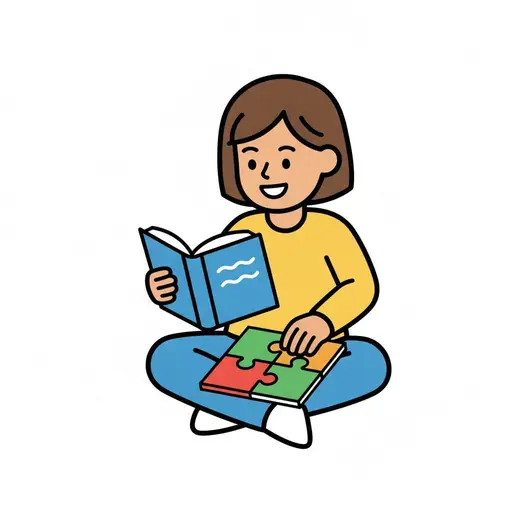
Read and do a puzzle
A girl sits cross-legged holding an open blue book with a colourful jigsaw in he...

Read on your own
A boy holds an open book and reads on his own.
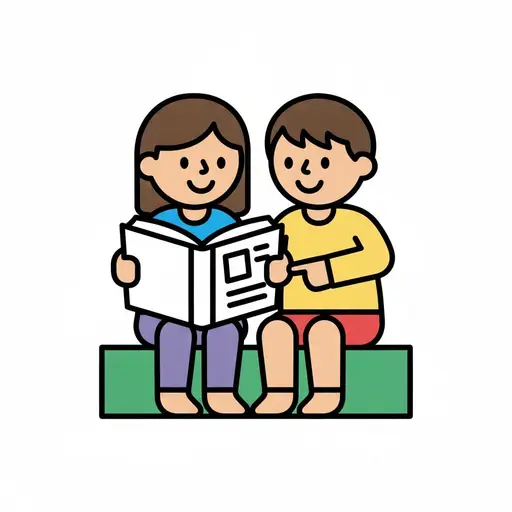
Read together
A girl and a boy sit on a green bench reading a book, one of them pointing at th...
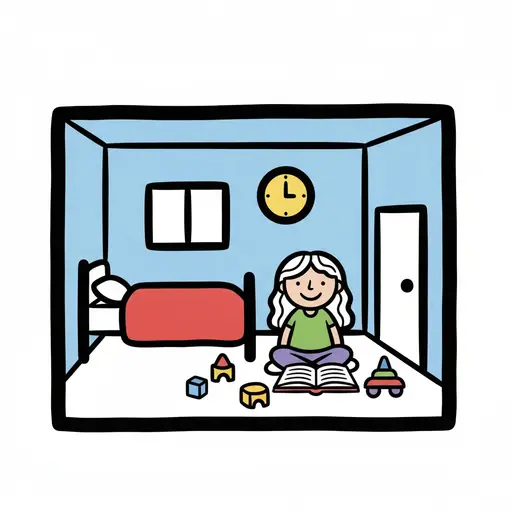
Room time
A girl sits on her bedroom floor with an open book and building blocks around he...

Activities
A child surrounded by icons for a book, paint palette, ball and building block.

Activity
Inside a dashed circle a girl runs along holding a paintbrush in one hand and a ...
Take the visual supports with you
In Routined you build schedules from these pictures, add timers and voice instructions, and your child follows the day on their own.


* 14-day free trial included for new users.