Family Meeting: A 15-Minute Agenda That Actually Works With Children
A family meeting only works if it stays short and predictable. Here is a four-point agenda that fits in 15 minutes, how to adapt it from age 4 to 14, and what to do when it turns into blaming.
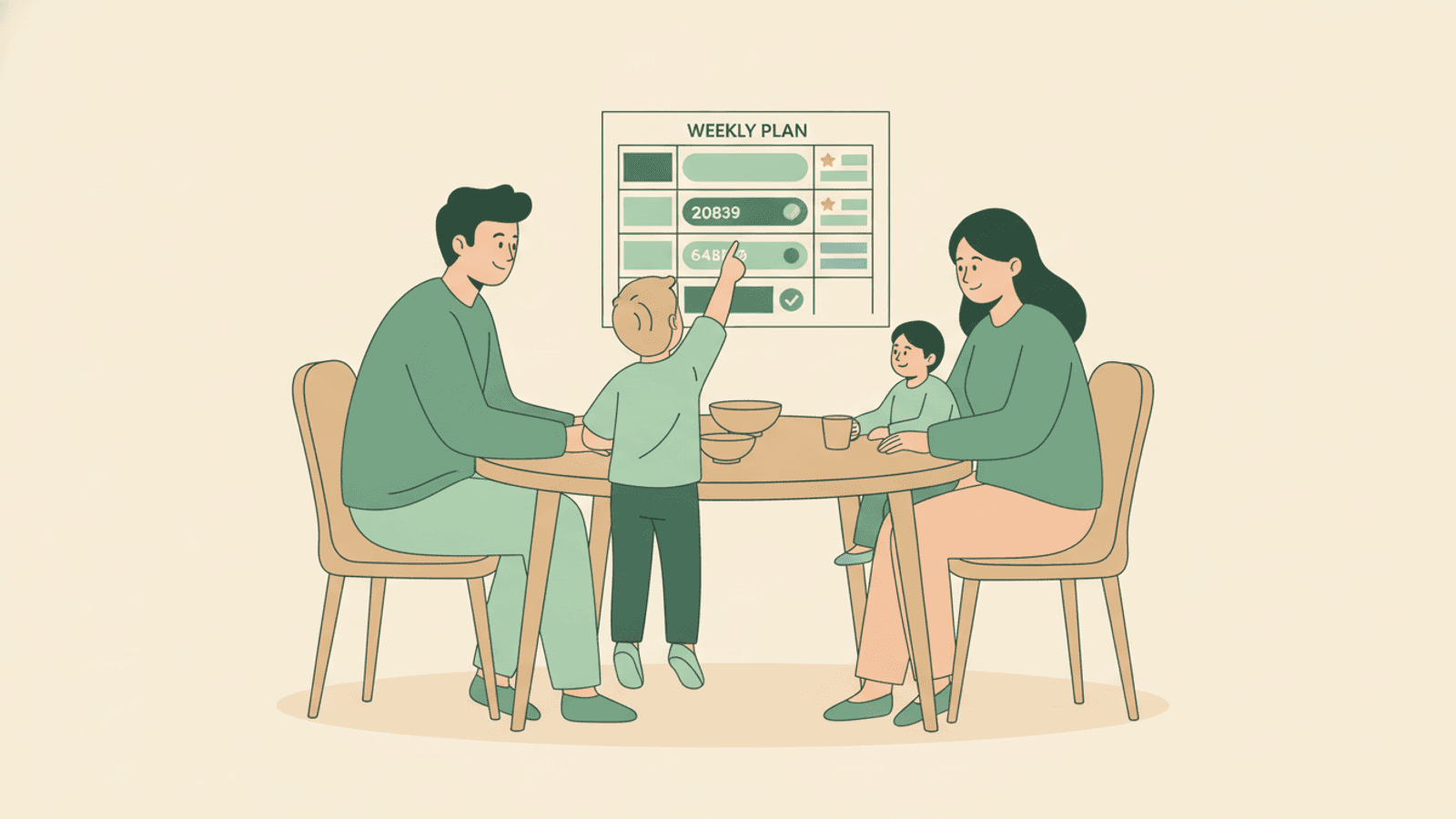
A family meeting is a short, scheduled conversation where everyone in the household sits down together to plan the week, solve one or two practical problems, and make decisions out loud instead of through nagging. It works best when it is predictable, brief, and the same every time: same day, same length, same four points. Fifteen minutes once a week is enough, and it beats an hour-long meeting once a month.
Most families who try family meetings quit within a month. Almost always for the same three reasons: the meeting was too long, the topics were too abstract for the children in the room, or it quietly turned into a list of complaints about the kids. All three are fixable, and none of them require a personality change from anyone.
What a family meeting is, and what it is not
A family meeting is a decision-making forum. Someone raises a real, concrete problem ("mornings are chaotic", "nobody knows who is picking up on Thursday"), the family picks one thing to try, and it gets written down. That is the whole mechanism.
It is not a trial. It is not a weekly review of who behaved badly. It is not a lecture in disguise, and it is not the place to discuss anything that would embarrass a child in front of a sibling. Those conversations belong one-to-one, later, in private.
If your children start disappearing when the meeting is announced, that is usually good feedback: the meeting has become a place where things happen to them rather than with them.
Why predictability makes a family meeting work for neurodivergent children
Children with ADHD or autism are not against structure. They are against structure that arrives without warning and changes shape every time. A family meeting that always starts at the same time, in the same spot, with the same four points and a visible end point is much easier to sit through than a spontaneous "family talk" that could last five minutes or forty.
A few practical adjustments that make a real difference:
- Announce it in advance and keep the same slot every week, for example Sunday after dinner.
- Set a visible timer so the end is not a mystery. Fifteen minutes means fifteen minutes.
- Allow movement. Standing, drawing, fidgeting or lying on the floor does not mean not listening.
- Write the agenda where it can be seen, so nobody has to hold the whole meeting in working memory.
- Say what will be discussed before you start, so surprises are limited.
Ending on time matters more than finishing the agenda. A meeting that reliably ends when it says it will is a meeting people come back to.
A 15-minute agenda with four points
Use the same four points every week. The repetition is the feature, not a lack of imagination.
1. What went well this week (3 minutes)
Everyone, including the adults, names one thing that worked. It can be tiny. This is not a warm-up ritual you can skip; it is what stops the meeting from being associated with trouble.
2. What is happening this week (4 minutes)
Go through the calendar out loud. Practice, appointments, days off, who is picking up whom, anything unusual. For younger children, translate it into their day: "Wednesday is the day Grandma picks you up." Most weekday conflict is really an information problem.
3. One problem to solve (6 minutes)
One. Not four. Pick a concrete, recurring friction point and let everyone suggest solutions, children first. Then choose one thing to try for a week. "We will test this until next Sunday" is far easier to agree to than a permanent new rule.
4. Something to look forward to (2 minutes)
Decide one small nice thing: Friday film, baking, a walk, who chooses dinner on Saturday. End the meeting on the thing everyone wanted to be there for.
How to run it with a 4-year-old versus a 14-year-old
Ages 4 to 6
Keep it to five or six minutes and make it visual. Use pictures or simple drawings for the days of the week and for the choice on the table. Give the child one real decision that is genuinely theirs, such as which two mornings they want to pick their own clothes. Expect them to leave before the end, and let them.
Ages 7 to 10
This is the sweet spot. Children this age love having a job, so give them one: timekeeper, note-taker, or the one who reads the agenda aloud. They can handle a real problem-solving round if the problem is concrete and affects them directly.
Ages 11 and up
Teenagers will attend if the meeting has actual power. If every decision is made by the adults anyway, they are correct to opt out. Let them bring items to the agenda, and let at least one decision genuinely go their way. Fifteen minutes is a reasonable ask; forty-five is not. If they refuse, invite them without making attendance a battle, and keep the decisions written down where they can read them afterwards.
Let the child chair the meeting
From about age seven, hand over the chair. The child reads the four points, calls on people, and watches the timer. It changes the room instantly: it is much harder to experience a meeting as an interrogation when you are the one running it.
You keep the veto on safety and money. Everything else can genuinely be up for negotiation, and children can tell the difference between real influence and pretend influence within about two meetings.
Write the decisions down where everyone can see them
An unwritten decision does not exist by Wednesday. Write down what you agreed, in the child's own words if possible, and put it somewhere visible: the fridge, a whiteboard in the hall, or a shared list on a phone.
This also makes follow-up unemotional. Instead of "you never do what you promised", you point at the note and ask whether the experiment worked. If a decision was about a routine, it helps to build it into the routine itself rather than leaving it as a rule to remember. In Routined you can turn an agreed morning or evening routine into steps with pictures, a timer per step and a short voice recording that plays when the child opens the step, so the agreement lives in the routine instead of in your nagging.
When it derails into blaming
It will, sooner or later. Someone brings up an old injustice, a sibling defends themselves, and the meeting is gone. Three moves that work:
- Name it neutrally: "We are describing the problem now, not deciding whose fault it is."
- Move from person to situation: not "he always takes my things", but "we need a rule for borrowing".
- Park it. Write the topic on the agenda for next week and move on. Parking a topic is a real answer, not a brush-off, as long as it actually comes back.
If the meeting keeps collapsing into conflict between siblings, that is a separate problem to work on outside the meeting rather than something to solve in the room.
How often is realistic?
Weekly, and short. A monthly meeting has to cover a month, which makes it long, which makes it dreaded, which makes it the last one. Weekly meetings stay small because nothing has time to pile up, and the routine itself does most of the work after four or five repetitions.
Missing a week is not a failure. Skipping two in a row usually means the meeting is too long, and the fix is to cut it, not to try harder.
The one thing to decide at your first family meeting
Do not solve the biggest conflict in the house at meeting number one. Decide when the next meeting is. Day, time, length, and who chairs it. Write that on the fridge and end early.
If you have five minutes left, add one small concrete decision, such as who empties the dishwasher on which days, or what time screens go off on school nights. Small and finished beats big and unresolved. The point of the first meeting is not to fix your family; it is to prove that the meeting is short, safe and worth coming back to.
Read more
Frequently asked questions
How long should a family meeting be?
Fifteen minutes is enough for most families, and five to six minutes with preschoolers. Ending on time matters more than finishing the agenda, because a meeting that reliably ends when promised is one people keep attending. If you regularly run over, cut the agenda rather than extending the meeting.
How often should we hold family meetings?
Weekly works far better than monthly. A weekly meeting stays short because nothing has time to pile up, while a monthly one has to cover four weeks and quickly becomes something everyone dreads. Missing one week is fine; skipping two in a row usually means the meeting has become too long.
At what age can children take part in a family meeting?
From around age four, if you keep it to a few minutes and make it visual with pictures or drawings. From about seven, most children can handle real problem solving and can take a role such as timekeeper or note-taker. Teenagers will take part if the meeting has genuine influence over decisions.
Do family meetings work for children with ADHD or autism?
They often work well, provided the format is predictable: same day, same place, same points, and a visible end point. Allow movement, announce the topics in advance and write decisions down so nothing has to be held in memory. If sitting together is consistently overwhelming, shorten the meeting rather than dropping it.
What do you do when a family meeting turns into arguing?
Name it calmly, move the conversation from person to situation, and park the topic on next week's agenda if it cannot be resolved in a few minutes. Parking works only if the topic genuinely comes back. Conflicts that need a private conversation with one child should be handled one-to-one, not in the meeting.