Teaching Your Child to Tie Their Shoes Without the Frustration
Tying laces is not one skill but a chain of little ones. Break it into steps, practise off the foot in calm moments, and use two-colour laces to take the frustration out of teaching your child to tie their shoes.
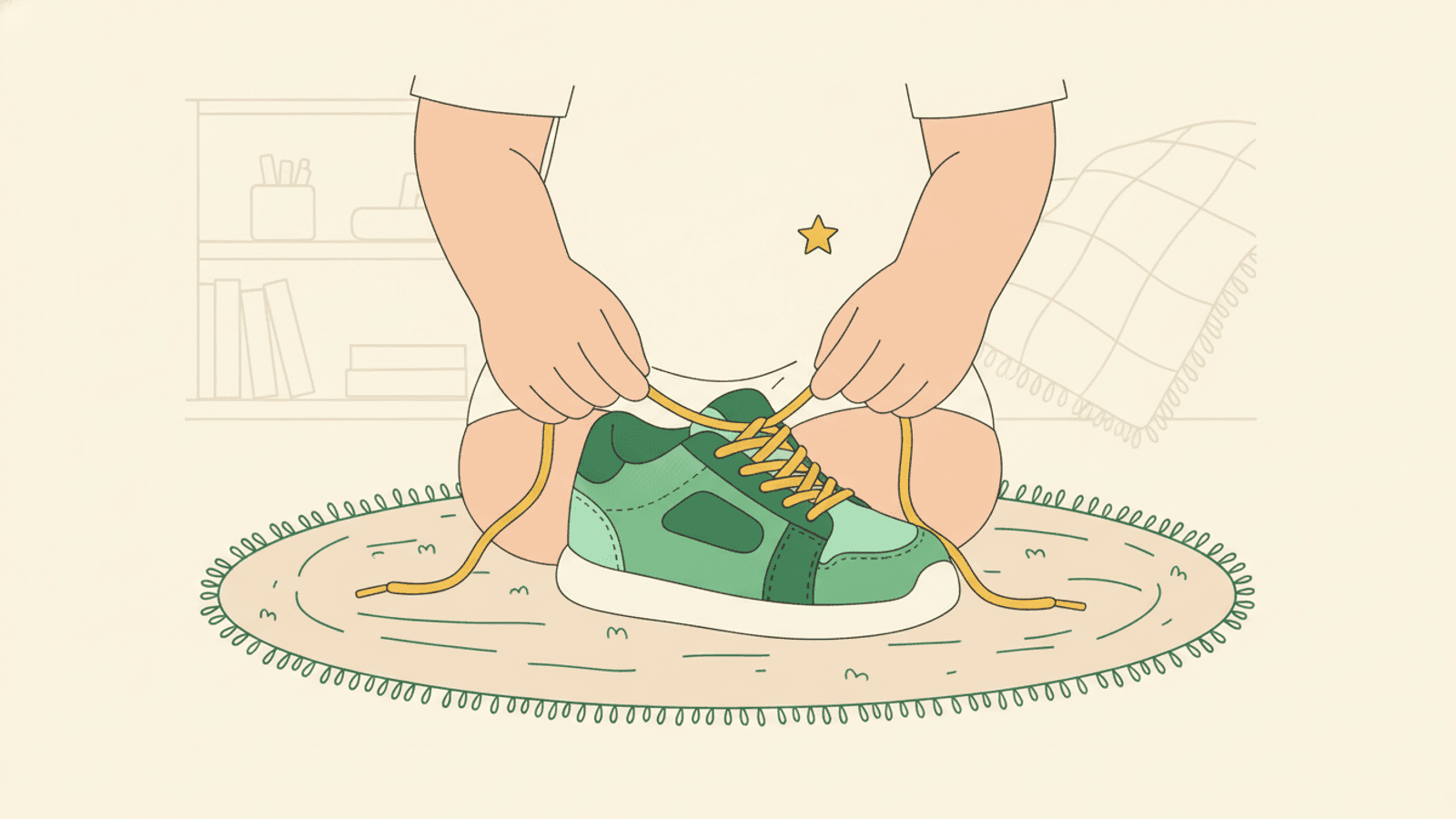
To teach a child to tie their shoes, break the skill into small steps, practise off the foot when nobody is in a hurry, and use two-colour laces so each hand knows what it is doing. Most children are ready somewhere between five and seven, once their fine motor skills have caught up. Tying laces is not one skill but a chain of little ones, and when you slow it down and remove the pressure, the frustration tends to melt away for both of you.
When is a child ready to learn to tie shoes?
There is no exact age. Many children can manage laces somewhere between five and seven, but plenty learn earlier or later, and that is completely normal.
What matters more than age is fine motor readiness. Can your child pinch a small object between finger and thumb, thread beads, or do up large buttons? Those are the same hand movements that tying needs. If pinching and threading are still tricky, spend a few weeks on those first and lace tying will come far more easily.
Why laces feel so hard (and why it is not your child's fault)
Tying a bow looks like one smooth motion to an adult, but for a child it is a long sequence of separate actions: cross, tuck, pull, make a loop, wrap, push through, pull tight. Miss one step and the whole thing falls apart.
When we show the finished bow at full adult speed, children see a blur. The trick is to make the invisible steps visible and to let your child master one at a time.
Break the skill into steps
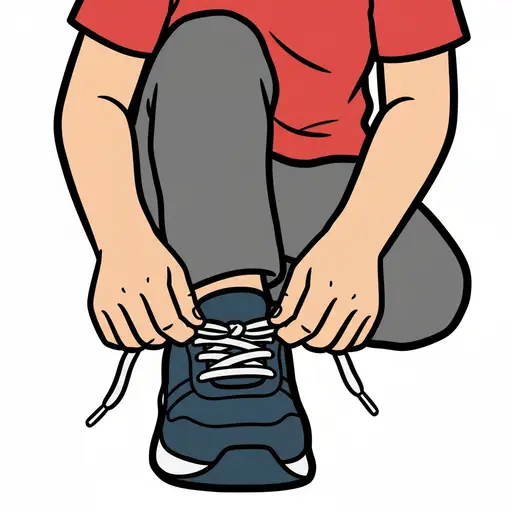
Before you start, decide on your steps and keep the same words every time. Consistent language does a lot of the teaching for you. A simple version looks like this:
- Pull both laces so the shoe is snug
- Cross one lace over the other to make an X
- Tuck one end under and pull to make the first knot
- Make a loop (a bunny ear) with one lace
- Wrap the other lace around the loop
- Push it through the hole and pull both loops tight
Say each step out loud as you do it. Over time your child will start saying the words with you, and the words become the memory.
Two popular methods
Bunny ears
Make a loop with each lace so you have two bunny ears, cross them, and pull one through. Many children find two loops easier to hold and see than the single-loop method. It is the most forgiving place to start.
Loop, swoop and pull
Make one loop, swoop the other lace around it, and pull it through the gap. This is closer to how most adults tie and needs a little more dexterity, so it is often the next step once bunny ears feel secure.
Neither method is better. Pick one, stick with it while your child is learning, and only introduce the other once the first is comfortable.
Practical tricks that make it click
Practise off the foot first
Take the shoe off and put it on the table, or lace a shoebox or a rolled-up towel. When the shoe is off the foot your child can see the laces straight on rather than upside down and far away, and they can turn it to whatever angle helps.
Use two-colour laces
Swap in laces that are two different colours, or knot a red lace and a blue lace together. Now you can say "loop the blue one, wrap the red one around it," and the instructions suddenly make sense. This one change removes a huge amount of confusion.
Never teach at the door on the way out
The worst time to practise is when you are late and everyone is standing in the hallway with coats on. Choose a calm moment on a lazy afternoon or at the weekend, when there is no clock ticking and no queue behind you. Learning happens best when nobody is rushed.
Be patient with plateaus
Skills like this rarely improve in a straight line. Your child might nail four steps, then seem to forget everything for a fortnight. That is a plateau, not a failure, and it is a normal part of learning.
Keep sessions short and cheerful, two or three minutes at a time, and stop before frustration builds. If a session is going badly, do the step your child can already do, celebrate that, and put the shoe away. Velcro shoes are a perfectly good bridge in the meantime. Wearing velcro to school takes the daily pressure off while you practise laces at home on your own terms.
Teaching a child with ADHD or dyspraxia
Children with ADHD, autism or dyspraxia often need more repetition and a more structured approach, and they may learn later than their peers. That is fine. The goal is a calm, predictable routine, not a race against the class.
A technique called backward chaining works especially well. You do all the steps yourself and let your child do only the very last one, pulling the loops tight. Once that final step is solid, you let them do the last two steps, then three, working backwards until they are doing the whole thing. Because they finish every attempt with success, motivation stays high.
Keep the environment low-stimulation, use the exact same words each time, and break the chain into even smaller pieces if you need to. Extra repetition is not a sign that something is wrong; it is simply what the skill costs for this child, and it is worth spending.
How Routined can help
If your child does better with pictures than with spoken instructions, a routine app can carry some of the load. In Routined you can build a short "tie my shoes" routine and choose Visual Support mode, which shows one big picture card per step from a built-in library, an AI image, or a photo you take yourself of your own hands doing each stage.
You can add an optional voice recording to each step that plays automatically when your child opens it, so your calm voice guides them through even when you are in another room. A gentle mood check before and after can show you whether the practice is feeling manageable, and a small reward shown as stars can keep motivation up during those repetitive backward-chaining days.
The takeaway
Teaching a child to tie their shoes is really about patience and pressure. Break the bow into named steps, practise off the foot with two-colour laces in calm moments, use backward chaining for children who need more repetition, and lean on velcro without guilt while you wait. Celebrate the small wins, expect a plateau or two, and trust that with enough unhurried practice, the loops really do click into place one day.
Read more
Frequently asked questions
At what age should a child learn to tie their shoes?
Most children are ready between five and seven, but it varies widely. Fine motor readiness, such as being able to pinch small objects and thread beads, matters more than the exact age.
What is the easiest method to teach shoe tying?
The bunny ears method is usually easiest to start with, because two loops are simpler to hold and see than a single loop. Move on to loop, swoop and pull once bunny ears feel secure.
How do two-colour laces help?
Using two different coloured laces lets you give clear instructions like "loop the blue one, wrap the red one around it." It removes confusion because each hand knows exactly which lace to work with.
How do I teach a child with ADHD or dyspraxia to tie shoes?
Use backward chaining: you do all the steps and let your child do only the final one, then gradually more. Keep the same words every time, practise in short calm sessions, and expect to need extra repetition.
Is it okay to keep using velcro shoes?
Yes. Velcro is a perfectly good bridge that takes the daily pressure off, especially for school mornings, while you practise laces at home in unhurried moments.